
Sign up for our newsletter
Subscribe to our emails
Help and support
Answers to the questions we're asked most often – from choosing a battery and charging to installation, delivery and warranty.
Find the right voltage and capacity for your usage.
8 spørgsmål
Start with the voltage of your system (12, 24, 36, 48, 60 or 72 V). Then choose the capacity (Ah) based on your consumption:
Ah ≈ (watts × hours) ÷ volts
If you use an inverter (230 V), add 10–15% for losses. Use our battery finder, or call us – and we'll work it out together with you.
Calculate the battery's energy in Wh: volts × Ah. A 12V 100Ah battery holds approx. 1.28 kWh (1,280 Wh).
Divide by your consumption: if you use 400 Wh per day, a 12V 100Ah battery will last approx. 3 days without charging. On the product pages, you can see guideline run times for typical appliances.
Motorhomes, caravans and smaller boats typically run on 12 V. For larger systems with an inverter – e.g. from approx. 2–3 kW – 24 V or 48 V is often better: a higher voltage means a lower current, so you can use thinner cables and get lower losses.
Golf carts and other electric vehicles need the same voltage as the vehicle (e.g. 36, 48 or 72 V).
Always compare batteries in Wh/kWh if they have different voltages.
One battery with the capacity you need is the simplest option: fewer cables, no balancing between batteries and easier troubleshooting. Several batteries let you expand later – but they must be the same model, capacity and age.
Our LiFePO4 batteries are leisure batteries (deep cycle) designed to power equipment over longer periods. Don't use them to start an engine unless the product page says the model is designed for it.
Compare the motor's power consumption with the battery's continuous current and peak current on the product page. The battery must be able to deliver more than the motor draws – including at start-up. If in doubt, send us the motor's specifications and we'll help.
We have LiFePO4 batteries (lithium iron phosphate) from 12 V to 72 V:
What you gain by switching – and what to check first.
4 spørgsmål
Yes, in most cases. Check three things first:
Send us the model names of your equipment and we'll check it for you.
No. Lithium and lead-acid must never be connected together in the same battery bank. If you connect several lithium batteries together, they must be the same model, the same capacity and the same age.
Lithium costs more up front, but it lasts many more cycles and lets you use more of the capacity. A lead-acid battery typically lasts 2–3 years. Over the battery's lifetime, the cost per cycle is therefore typically lower with lithium.
Chargers, charge voltages, alternator, DC-DC and solar.
11 spørgsmål
Yes, if it has a LiFePO4/lithium profile or can be set to approx. 14.2–14.6 V (12 V). Equalisation, desulphation/"repair" and temperature compensation must be switched off.
A pure lead-acid charger that stops at approx. 13.8 V won't fully charge the battery and can't balance the cells. In that case, we recommend a lithium charger.
Typical values for LiFePO4 – the datasheet for your model always takes precedence:
| Setting | 12 V | 24 V | 48 V (16 cells) |
|---|---|---|---|
| Charge voltage (bulk/absorption) | 14.2–14.6 V | 28.4–29.2 V | 56.8–58.4 V |
| Float (maintenance) | approx. 13.5 V or off | approx. 27.0 V or off | approx. 54.0 V or off |
| Equalisation (equalize) | Off | Off | Off |
| Temperature compensation | Off (0 mV/°C) | Off (0 mV/°C) | Off (0 mV/°C) |
For 36, 60 and 72 V: multiply 3.55–3.65 V by the number of cells stated in the datasheet. See also the user guide.
Yes, and we recommend a DC-DC charger (B2B). It limits the current so the alternator isn't overloaded, and provides the correct charge voltage for lithium. See e.g. Victron Orion DC-DC.
A smart alternator lowers the voltage while you drive, so a standard DC-DC charger may think the engine is off. Choose a DC-DC charger with a smart alternator setting, and connect a signal from the ignition (D+) if needed. Call us with your vehicle's model and year, and we'll find the right solution.
Yes, if the controller has a LiFePO4 profile or can be set manually: charge voltage 14.2–14.6 V (12 V), float approx. 13.5 V or off, and equalisation off. An MPPT controller makes better use of the solar panels than PWM.
Many control panels and built-in chargers in motorhomes and caravans have a LiFePO4 setting. Check the manual – or send us the model name and we'll check it. If it has no lithium profile, you can charge via a separate lithium charger or DC-DC charger.
As a rough guide: capacity (Ah) ÷ charger current (A) – plus a little extra at the end. An empty 12V 100Ah battery with a 20 A charger takes approx. 5–6 hours.
No. Lithium is fine with partial charging. However, do fully charge it regularly – e.g. once a month – so the BMS can balance the cells and the app shows the correct state of charge.
Typical causes:
Stay below the battery's max. charge current shown on the product page. A gentle charge current is approx. 0.2–0.5C – i.e. 20–50 A for a 100Ah battery.
Yes, but via a charger – e.g. a lithium charger or an inverter/charger such as the Victron MultiPlus. Never connect the generator directly to the battery.
Series and parallel, cables, fuses and placement.
8 spørgsmål
Many of our batteries can be connected in series and/or parallel. How many – and how – depends on the model, so check the product page or ask us first.
See the step-by-step instructions in the user guide.
It depends on the model – see the product page or ask us. Never mount the battery with the terminals facing down, and always secure it properly.
The cables and fuse must match the current your system draws – including at peak. Fit the fuse on the positive cable as close to the battery as possible. The fuse must protect the weakest link, usually the cable.
Example: our 12V 100Ah can deliver 150 A continuously and 200 A peak. See battery cables and fuses and accessories – or give us a call and we'll help with the sizing.
LiFePO4 does not give off gas during normal use, so the battery can be placed indoors or in the cabin. Place it somewhere dry, away from heat sources and direct sunlight, with a little air around it. In vehicles and boats, the battery must be secured so it cannot move during braking or in rough seas.
The battery must not stand in water or be splashed. Place it somewhere dry and protected. If an IP rating is stated on the product page, it tells you how much dust and water the casing can withstand.
Use the tightening torque stated in the datasheet, ideally with a torque wrench. Loose connections get hot and can damage the battery. Check the terminals again after a few weeks and regularly after that.
Many people install a 12 V battery in a motorhome, caravan or boat themselves – follow the user guide. Anything connected to the home's 230 V installation or the grid must be carried out by an authorised electrician.
The JK BMS app, Bluetooth and what the alarms mean.
7 spørgsmål
BMS stands for Battery Management System – the battery's built-in control system. It protects against overcharging, deep discharge, excessive current, short circuits and excessively high or low temperatures. It also balances the cells so they have the same voltage.
All LithiumPro batteries with JK BMS: download JK BMS from the App Store or Google Play (also listed as JIKONG BMS).
LithiumPro 12V 50Ah (the world's smallest): download Xiaoxiang Electric – the icon is a white elephant on a blue background. If the app plays up, you can use Overkill Solar (iPhone and Android) or Fusion BMS (iPhone).
Lithium has a very flat voltage curve, so the percentage is calculated from the current flowing in and out – and it can drift slightly over time. Fully charge the battery to reset the display to 100%. Use the app rather than a display on the battery as your main source.
No. The BMS is set at the factory for the battery's cells. Do not tap presets such as LiFePO4, Li-ion or LTO, and do not change protection values. Any changes are made at your own risk and are not covered by the warranty or your statutory rights.
Usually not. The BMS has switched the battery off to protect the cells. Remove all loads and connect a charger with a LiFePO4 profile – some chargers have a special function to "wake up" lithium batteries. Charge as soon as possible: if the battery is left fully discharged for a long time, the cells can be permanently damaged. Contact us if it doesn't wake up.
Charging in frost, capacity in the cold and winter storage.
6 spørgsmål
No. LiFePO4 batteries must not be charged below 0 °C. The BMS automatically stops charging when it's too cold and resumes once the battery has warmed up. The battery can still deliver power down to -20 °C.
Yes, temporarily. In the cold, the battery may deliver less than usual, but the capacity returns once it warms up again. It's the battery's own temperature that counts – not the air outside. You can see it in the app.
The BMS blocks charging below 0 °C. If your motorhome or boat is laid up over winter, you can also switch off the solar charge controller or use a temperature sensor that stops charging in frost.
Typically approx. 2–3% per month. Small loads such as alarms, the BMS and Bluetooth also draw a little, so disconnect the battery completely when it won't be used for a long period.
Hardly any. There's no fluid to top up. Regularly check that the terminals are tight and clean, and fully charge the battery from time to time so the cells are balanced.
Cycles, lifespan, safety and used batteries.
4 spørgsmål
Our LiFePO4 batteries with EVE Grade A cells handle over 9,000 charge cycles at 80% depth of discharge and have an expected lifespan of up to 20 years. The lifespan depends on how deeply you discharge, the temperature and how the battery is charged.
You can use up to approx. 90% of the capacity without damaging the battery. If you recharge before the battery is completely flat, it will last longer. A 12 V battery must not be discharged below 10 V.
LiFePO4 is one of the most thermally stable lithium chemistries, and the BMS protects against overcharging, short circuits and excessive current. The risks come from physical damage, short circuits, incorrect charging or charging in frost – so follow the user guide.
Batteries must never be thrown away with household waste. If you bought the battery from us, we'll take it back – contact us first and we'll agree on how it should be dropped off or sent. You can also take it to your local recycling centre. LithiumPro is registered with Dansk Producentansvar. Read more about used batteries.
Delivery times, shipping, payment and price comparison.
6 spørgsmål
Delivery usually takes 2–4 working days. Special batteries and items we don't have in stock may take up to 1 week. You'll receive an email with a tracking number once your parcel has been dispatched. Read more in our delivery terms.
The shipping cost depends on the delivery method and is always shown at checkout before you pay.
Yes. We ship throughout Denmark as well as to Sweden and Germany. If you need delivery to another country, contact us and we'll find a solution. Lithium batteries are shipped as dangerous goods, so not all shipping methods are possible.
You can pay by card, MobilePay, Apple Pay, Google Pay and Klarna, among others. The options available for your order are shown at checkout.
Yes. Choose Klarna at checkout to pay later or split the payment.
On selected Victron and Deye products, we show the typical price of the same item at other Danish retailers (the median of the prices we have found). It's there so you can easily compare. We check the prices regularly, but other retailers' prices may change.
Right to cancel, warranty, claims and returning lithium batteries.
8 spørgsmål
Yes. As a private customer, you have a 14-day right to cancel from the day you receive the item. Notify us in writing at info@lithiumpro.dk within those 14 days. You then have 14 days to return the item.
You pay the return shipping yourself. We refund the purchase amount, including the original shipping, no later than 14 days after we have received the item. Custom-made batteries and customised solutions cannot be cancelled. Read more and find the cancellation form on our right to cancel page.
Contact us before you send anything. Lithium batteries are dangerous goods, and not all carriers are allowed to take them. We'll tell you how the battery should be packed and shipped. Ideally, use the original packaging.
The exact warranty is stated on the product page. Read the terms in our terms and conditions.
The warranty covers faults in the battery itself – e.g. if the cells, BMS or electronics fail. We then troubleshoot and repair it at our expense, and in the worst case you get a new battery.
It does not cover a battery that has been dropped or knocked, opened or modified, installed incorrectly or short-circuited, charged with the wrong charger or voltage, loaded beyond its specifications, or has water or fire damage – nor normal loss of capacity over time.
Statutory rights give you a legal right to claim for 24 months if the item was faulty when you received it. The warranty is our additional promise of 3 years (or 8 years with the extended warranty) on LithiumPro batteries. The warranty does not limit your statutory rights.
Email info@lithiumpro.dk with:
Don't send the battery until we've agreed on it. We'll assess the case and find a solution: repair, replacement or refund. See the full procedure under warranty and claims.
Take photos of the packaging and the item, and contact us as soon as possible at info@lithiumpro.dk. We'll then help you find a solution and with any claim against the carrier. Do not use a battery that is damaged.
No. The extended warranty must be purchased in the same order as the battery and only applies to the battery it was bought for.
Installation, permits, savings and backup.
9 spørgsmål
Everything is carried out by external, authorised electrical installers and qualified engineers with many years of experience. We make sure everything complies with current rules and legislation. If you'd rather handle the installation yourself, you can also buy the components as a complete package.
No. We take care of that for you – including grid connection, notification to the local authority and grant applications where possible.
South-, east- and west-facing roofs can all be used. The most important thing is that there is as little shade as possible during daylight hours. We assess your roof – pitch, orientation and shading – and tell you whether it's worthwhile.
It depends on your electricity consumption, when during the day you use the power, the electricity price and whether you have a battery. With a battery, you can store solar power from the daytime and use it in the evening, so you buy less electricity from the grid. Build your system in the solar guide and get an overview of the price.
Start with your annual electricity consumption (shown on your electricity bill). Call us or use the solar guide, and we'll find a size that suits your consumption and your roof.
Only if the inverter has a backup function (EPS/off-grid) and the appliances that need power are connected to the backup output. A standard grid-tied inverter shuts down for safety reasons when the grid is down. Many hybrid inverters – e.g. from Deye – have a backup output. Ask us if backup is important to you.
Yes, usually. Either by adding a battery system with its own inverter (AC coupling) or by switching to a hybrid inverter. Send us details of your system and we'll assess it.
Solar panels typically last 25–30 years and the inverter 10–15 years.
Hardly any. An annual inspection and cleaning if needed are recommended to keep the output high.
Compatibility, BMS and setup.
4 spørgsmål
Yes. Our batteries can be used with Victron chargers, inverters, MultiPlus and SmartSolar MPPT – set to LiFePO4 as shown in the table under "Charging and chargers". Selected models have CAN/RS485. If the battery needs to communicate with a Victron GX system, ask us before you set it up.
Yes. Victron Smart LiFePO4 batteries must be used with a Victron BMS – e.g. smallBMS, VE.Bus BMS V2, Lynx Smart BMS or Smart BMS CL 12/100, depending on the system. Our own LithiumPro batteries have a built-in BMS.
A standard inverter converts 12/24/48 V from the battery into 230 V. A hybrid inverter can also manage solar panels, the battery and the grid at the same time – and many have a backup output.
Yes. Call us and we'll help with the settings in VictronConnect. If you've forgotten the PIN code for a Victron product, it can be reset using the PUK code on the product label.
Sales to businesses and special batteries.
3 spørgsmål
Yes. We sell to both private customers and businesses and are happy to provide quotes for larger quantities and projects. Contact us with your CVR number and requirements.
No. The right to cancel only applies to consumers, unless otherwise agreed in writing.
Yes. We make tailor-made batteries for niche applications. Tell us the voltage, capacity, current and dimensions, and we'll get back to you. Please note: custom-made batteries cannot be cancelled or returned.
Phone, email and shop in Ringsted.
2 spørgsmål
Support and sales are open 24/7. Call +45 60 46 84 10 or email info@lithiumpro.dk. You can also use the form on our contact page.
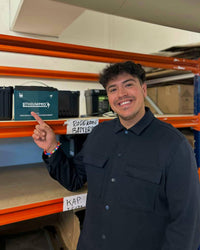
Yes. Our shop at Bringstrupvej 71, 4100 Ringsted is open 10am–8pm by appointment. Call +45 60 46 84 10 to book a time.
Personal advice
Call and talk to someone who knows the batteries. We help with choosing, setup and troubleshooting – even after you've bought.

Support and sales 24/7
Subscribe to our emails